
ByteDance released its next-generation video creation model, Seedance 2.0, this Thursday.
Seedance 2.0 adopts a unified multimodal audio and video joint generation architecture, supports four modal inputs: text, images, audio, and video, and integrates the most comprehensive multimodal content reference and editing capabilities in the industry.
Compared to version 1.5, Seedance 2.0 has significantly improved the quality of its output. It is more usable in complex interaction and motion scenarios, and its physical accuracy, realism, and controllability are significantly enhanced, making it more suitable for the needs of industrial-grade creative scenarios.
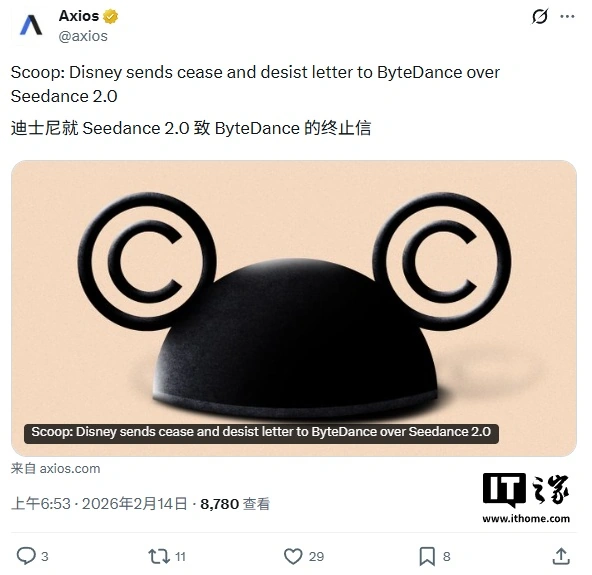
According to a copy of the letter obtained by Axios, The Walt Disney Company sent a letter to ByteDance on Friday, accusing the company of using Disney works without permission in training and developing Seedance 2.0 models, and demanding that ByteDance “cease the infringement and refrain from doing so again.”
The letter, written by Disney lawyer David Singer and addressed to John Rogovin, ByteDance’s global general counsel, alleges that ByteDance’s Seedance service “pre-loaded” a library of pirated material containing Disney copyrighted characters, including IPs from Star Wars and Marvel, and that Disney’s actions made it seem as if these highly commercialized IPs were “free public domain clip art.”
Disney further stated that despite its public opposition, ByteDance continues to “hijack” Disney characters by copying, distributing, and creating derivative works, describing this behavior as “virtual looting and vandalism,” and calling it “deliberate, widespread, and utterly unacceptable.”
In his letter, David Singer also emphasized that the copyright infringement on Seedance may only be “the tip of the iceberg,” and this judgment is shocking because Seedance has only been online for two days.
To substantiate the infringement allegations, Disney listed several examples in the letter, stating that Seedance-generated videos featured multiple Disney copyrighted characters, including Marvel’s Spider-Man, Star Wars’ Darth Vader, and Peter Griffin from Family Guy.
Disney also pointed out that the fact that these videos were publicly posted on social media by users indicates that the infringement has reached a considerable scale. Disney further accused Seedance of profiting from this unauthorized copyrighted content as a commercial service.
In addition, Charles Rivkin, president and CEO of the Motion Picture Association of America (MPA), issued a statement on Thursday demanding that ByteDance “immediately cease its infringing activities.” Meanwhile, the Human Artistry Campaign (a creative industry alliance that includes SAG-AFTRA and the Directors Guild of America, among others) also stated on Friday that law enforcement agencies should use “all legal tools” to stop this “large-scale theft.”
In recent years, Disney has taken a proactive approach to dealing with copyright infringement by AI companies, and has achieved some results. For example, in September last year, Disney sent a letter to Character.AI , after which Character.AI adjusted its use of Disney copyrighted characters; in December last year, Disney also sent a letter to Google, after which Google removed dozens of unauthorized AI-generated videos featuring Disney characters.
Last June, Disney and NBCUniversal also filed a lawsuit against Midjourney, making it one of the first Hollywood studios to sue a generative AI company; later, Disney, NBCUniversal, and Warner Bros. Discovery also joined forces to sue MiniMax, accusing it of massively misappropriating content from their respective film libraries.
At the same time, Disney emphasized that it is not entirely opposed to AI collaborations, but rather hopes to advance collaborations under “appropriate conditions.” For example, last year Disney reached a comprehensive collaboration agreement with OpenAI, becoming the first major content licensing partner for the Sora social video platform, and agreed to make a $1 billion equity investment in OpenAI.