
The official WeChat account of Zhejiang University published a blog post today (July 17) stating that its research team has overcome the bottleneck in the synthesis of high-priced anticancer drugs, achieving a yield of vinblastine, the direct precursor of vinblastine, in yeast of 164.9 mg/L, nearly 1000 times higher than previously reported levels.
According to a blog post cited by Tech free press, the only known natural source of the clinically used anticancer drug vincristine is the periwinkle. However, it takes 2,000 kilograms (2 tons) of dried periwinkle leaves to extract just 1 gram of vincristine. The extremely low natural content has long made this life-saving drug face the problems of high cost and unstable supply.
A team led by Professor Lian Jiachang from the College of Chemical Engineering and Biotechnology at Zhejiang University and the Hangzhou International Science and Technology Innovation Center, in collaboration with the team led by Qu Yang from the University of New Brunswick in Canada and the team led by Wang Yajie from Westlake University, has successfully broken through the bottleneck that has long restricted the low yield of artificial synthesis of vincristine after years of research.
The findings were accepted by the top international journal Science and were published online as a first release in the early morning of July 17th, Beijing time.
The research foundation can be traced back to 2022. At that time, Lian Jiachang’s team had introduced the 30-step reaction of the key synthetic pathway of vincristine precursor into Saccharomyces cerevisiae, but the yield remained at the microgram per liter level for a long time, failing to reach the threshold of industrialization.
In subsequent studies, the research team determined that the limiting factor was related to the efficiency of intracellular intercompartmental transport. During further inter-team discussions, a gene called CAD2 came into focus. Previous virus-mediated gene silencing experiments had shown that turning off CAD2 reduced vincristine production to 10% of its original level.
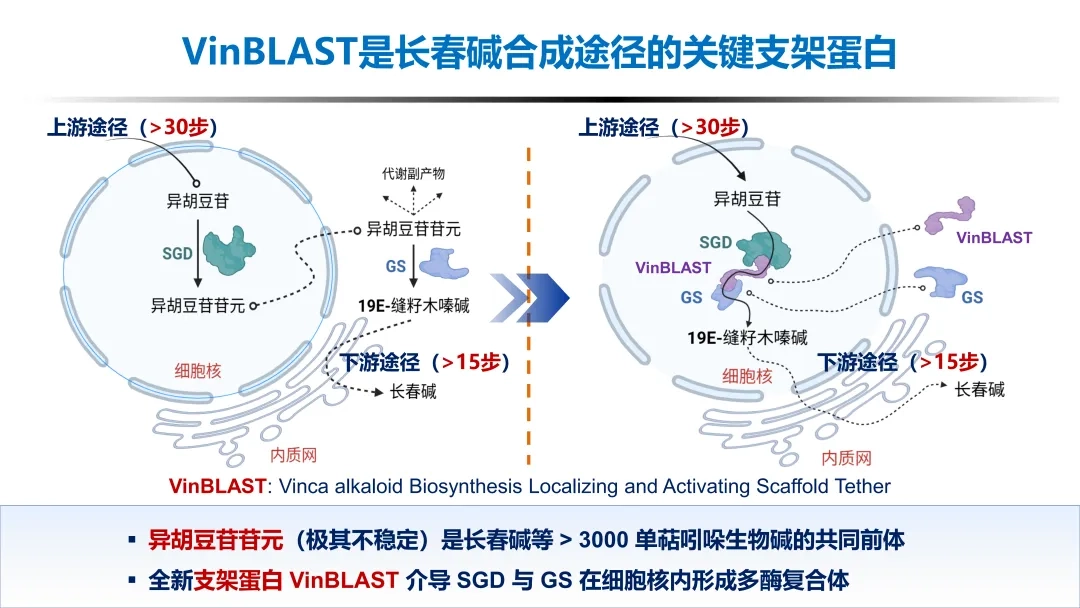
The joint team subsequently confirmed that the key protein corresponding to CAD2 can significantly improve this metabolic node and named it VinBLAST (vincrine biosynthesis scaffold protein).
This protein binds to SGD enzyme at one end and GS enzyme at the other end, causing the two originally separate reactions to form a stable multi-enzyme complex in the cell nucleus, reducing intermediate transcompartment transport losses.
Through the combined effects of spatial recombination and enhanced enzyme activity, the yield of vincristine, the direct precursor of vinblastine, in yeast reached 164.9 mg/L, nearly 1000 times higher than previously reported levels. The team is currently collaborating with relevant institutions to continuously advance the large-scale preparation of vinblastine and other alkaloids