

Schrödinger posted on Telegram that since last year, Samsung has been trying to combine the superior properties of titanium and aluminum to create a new “dual-phase” body frame that combines sturdiness and heat dissipation.
This frame will be used in Samsung’s future foldable phone product line. Its exterior is made of a robust and scratch-resistant titanium alloy, while its interior uses aerospace-grade aluminum as the core material. The highly thermally conductive aluminum core acts as a “giant heat sink,” rapidly dissipating heat from the motherboard.
Schrödinger believes that Samsung’s hybrid “dual-phase” frame is undoubtedly a response to Apple’s innovations related to liquid metal.
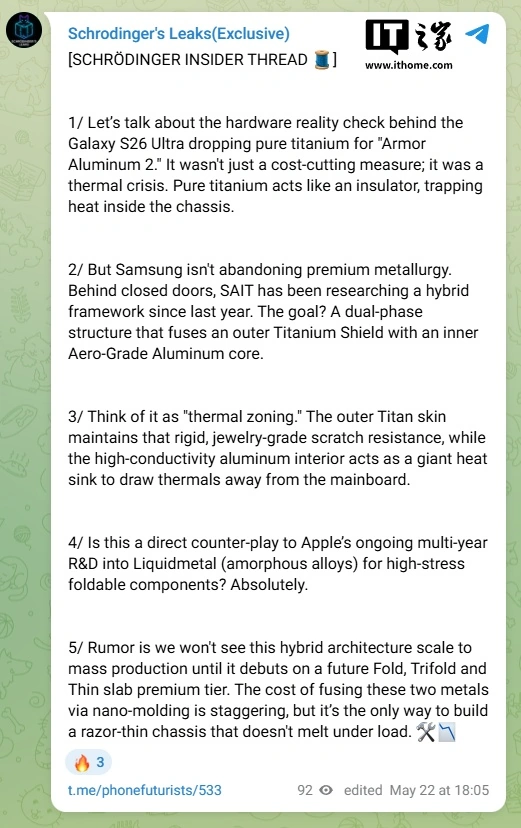
This technology is expected to debut on “future Fold, tri-fold, and ultra-thin high-end flagship models,” especially considering that the cost of fusing these two different metals through nano-injection molding/nano-forming technology is “extremely high.”
Public reports indicate that Apple’s “Liquidmetal” is essentially a marketing brand name for an “amorphous alloy.” This alloy is rapidly cooled during manufacturing, causing its atoms to exhibit a chaotic, disordered arrangement similar to glass. The resulting metal is approximately 1.5 times harder than stainless steel and 2.5 times stronger than standard titanium, while still being able to bend under stress.
Of course, due to the extremely high costs involved, both Samsung and Apple are expected to apply these innovations only to their respective ultra-high-end product lines. For example, it is widely believed that Apple will use a liquid metal hinge in the upcoming iPhone Ultra.